

You have no items in your shopping baskey.



Riser Recliner Chair Buying Guide: How to Choose the Right Chair
If getting out of an armchair has started to feel like hard work, a riser recliner chair is usually the first thing people look at. It can feel like a lot to take in at first, but there are really only a handful of decisions to make. How many motors you need, what size seat, fabric or leather, and whether you should be paying VAT on it at all.
This guide works through each of those in plain English, whether you're buying for yourself or helping a parent, partner or someone you care for. Take your time with it, and when you're ready, browse our full range of rise and recline chairs or come and sit in a few in person in our showrooms in Essex and London.
What Is a Riser Recliner Chair?
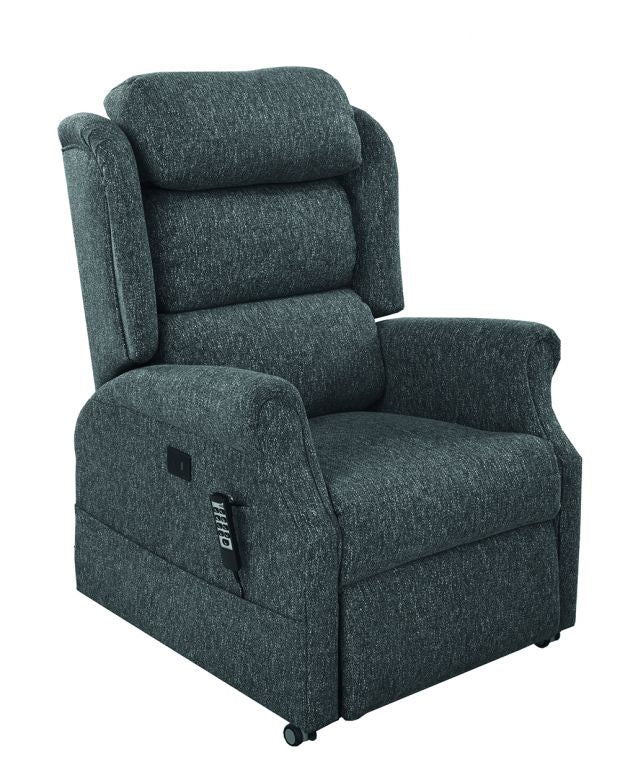
A riser recliner chair is a powered armchair that reclines like an ordinary recliner and also tilts forward to lift you gently towards a standing position. Also known as a rise and recline chair, it's designed for people who find getting in and out of a normal armchair difficult.
The rise function is the part that makes the difference. At the press of a button the seat lifts and tips forward, so you finish the movement close to standing rather than pushing up out of a low seat with your arms.
People look at one after surgery, when a long-term condition affects strength or balance, or simply when a favourite armchair has become hard to leave. Whether a chair suits a particular person is a conversation for an occupational therapist, your GP or our showroom team.
It's a common situation. ONS figures show the number of people aged 65 and over living alone in the UK rose to 4.3 million in 2024, up from 3.5 million a decade earlier, and the DWP Family Resources Survey found mobility was the most commonly reported impairment among disabled pensioners, affecting 68% of that group.
Motor Types: Single, Dual and Quad Motor Chairs
Riser recliner chairs come with one, two or four motors. A single motor moves the backrest and footrest together. A dual motor controls them independently. A quad motor adds a powered headrest and lumbar support. More motors mean more positions to choose from, and usually a higher price.
Single motor: One motor drives the backrest and footrest together, so as the chair reclines the footrest rises at the same time. You can't separate the two. What you get in return is simplicity, and that counts for a lot. Fewer buttons to coordinate suits anyone finding dexterity or eyesight difficult, and these chairs sit at the more affordable end of the range.
Dual motor: Two motors mean the backrest and footrest work independently. You can put your feet up while staying upright to read or watch television, or lie the backrest right back with the footrest down. That matters most for anyone spending several hours a day in the chair, because you can shift your legs without moving everything else. Each motor also has one job rather than driving two linked movements, so the mechanism works under less strain.
Quad motor: A four motor chair adds a powered headrest and powered lumbar support, each adjustable from the handset. It gives you the finest control over how the head, neck and lower back are supported, and it's the highest specification and the most expensive.
Tilt-in-Space Chairs and Pressure Care
Tilt-in-space and ordinary recline get confused a lot, and they aren't the same thing. In a standard recliner the backrest moves independently of the seat base, so the angle at your hips opens as you lean back. In a tilt-in-space chair the whole seat and backrest tilt backwards as one piece, so the hip angle stays the same throughout.
That changes how weight is carried. Sitting upright, most of your weight passes through the buttocks and thighs. Tilting the whole seated unit shifts some of that load through the legs and the back of the chair, spreading it over a larger area, and because the hip angle is fixed the body doesn't slide forward on the seat the way it can with a backrest-only recline.
Getting the Right Fit and Weight Capacity
Fit is what decides whether a chair actually helps. If someone struggles to stand, the size of the seat is usually the real barrier, not the motor count or the price. A chair that costs more but sits too deep or too high is still hard to get out of.
Seat height: Measure from the floor to the crease at the back of the knee, sitting with the bottom against the back of the chair and hips and knees at roughly 90 degrees. In the chair, feet should sit flat on the floor. Too high and the feet dangle. Too low and standing gets harder, even with a powered rise.
Seat depth: Measure from the back of the bottom along the thigh to around 3cm behind the crease at the back of the knee. A quick check when sitting fully back is a gap of about two fingers' width between the front edge of the seat and the back of the knee. Less than that and the seat is too deep. Much more and the thighs aren't properly supported.
Seat width: Measure across the widest point of the hips while seated, then allow roughly 2.5cm either side for comfort and movement.
Back height: Measure from the seat cushion to the top of the backrest. This one varies more between people than the others, depending on torso length and how much head and neck support you want.
Weight capacity: Maximum user weight varies by manufacturer and model, so check the specification for the chair you're looking at rather than assuming a standard figure. Bariatric models with reinforced frames are available where a higher capacity is needed. If you're unsure, or the fit is complicated by height, body shape or posture, ask us for a home assessment.
If the person using the chair transfers in and out of a wheelchair, matching the seat heights makes side transfers easier, and the right wheelchair accessories can help too.
Wall-Hugger Chairs for Smaller Rooms
A standard riser recliner pivots backwards as it reclines, so it needs a decent gap behind it to open fully. A wall-hugger, sometimes called wall-away, works differently. The seat glides forward along a track as the backrest goes back, so the chair travels away from the wall rather than into it. That's what lets it sit close to a wall and still recline fully.
Exact clearances differ by model, so check the manufacturer's specification or ask us rather than working from a general figure. The principle is simple enough. If the room is small, or the chair has to go against a wall or into a bay window, start with a wall-hugger.
It's worth measuring the route in as well, the front door, any turns in the hallway and the doorway into the room, since riser recliners are heavier and bulkier than they look. Check there's a mains socket within reach of where the chair will sit, as it needs to stay plugged in, and ask our delivery team about access before you order.
Fabric or Leather: Choosing and Caring for Your Chair
There's no right answer here, just a trade-off between how the chair feels and how easy it is to look after.
Fabric: Warmer and softer to sit on, it doesn't go cold in winter or sticky in summer, and it comes in a wider range of colours, which matters if the chair has to look like furniture rather than equipment.
Leather and faux leather: Wipes clean in seconds. Spills sit on the surface instead of soaking in, and the material stands up better to repeated cleaning. Faux leather gives you most of that practicality at a lower price than real leather.
If continence is a consideration, and for a lot of families it quietly is, leather or faux leather is the more practical choice, and it's worth asking about wipe-clean fabric options too. It comes up all the time, so there's nothing awkward about raising it with us. Whichever you choose, follow the manufacturer's cleaning guidance rather than reaching for a household cleaner.
Made to Measure and Prescription Chairs
Standard sizes suit most people, but not everyone. If someone is particularly tall or short, has an unusual seated shape, or needs specific support built into the seat or back, a made to measure chair is built to their measurements rather than to an average.
That matters more here than it would with ordinary furniture. An armchair that's slightly the wrong size is a comfort problem. A powered chair that's the wrong size can stop doing the job it was bought for, because the rise only helps if the seat presents you at the right height and angle to stand from.
We offer a made to measure service by appointment for anyone who needs a prescription chair built to their own dimensions. It starts with proper measurements and a conversation about how and where the chair will be used.
VAT Relief and Help Paying for Your Chair
If you're chronically sick or disabled and buying a chair for your own personal or domestic use, you shouldn't pay VAT on it. HMRC's VAT Notice 701/7 names riser recliner chairs specifically, as long as the chair has a genuine powered lift and tilt facility.
The notice zero rates "a hoist or lifter designed for use by people with disabilities", and states this "includes riser-recliner chairs, sometimes also called lift and tilt chairs, but does not include recliner chairs which do not have the lift or tilt facility". A chair that only reclines doesn't qualify. A chair that lifts you towards standing does.
Who counts as chronically sick or disabled: HMRC's definition covers a physical or mental impairment with a long-term and substantial adverse effect on the ability to carry out everyday activities, or a condition the medical profession treats as a chronic sickness. The notice is equally clear about who isn't covered: an older person who isn't disabled or chronically sick, and anyone only temporarily incapacitated, such as with a broken limb. Age alone doesn't qualify you.
How the relief is applied: You sign a written declaration confirming you're entitled to it, and the retailer keeps that on file. You don't need a doctor's letter or medical evidence, and HMRC itself says it cannot tell an individual whether they're chronically sick or disabled. Where someone can't sign for themselves, a parent, guardian, doctor or other responsible person can sign on their behalf. It isn't a formality to skate over though. The notice warns there are penalties for knowingly accepting false declarations and for fraudulent evasion of VAT, so if you're genuinely unsure whether you qualify, take advice before signing.
A common mix-up: there's a separate scheme charging 5% VAT rather than 20% on certain mobility aids for people aged 60 and over. That one applies to a fixed list of installed mobility aids: grab rails, ramps, stair lifts, bath lifts, built-in shower seats and walk-in baths with sealable doors. Riser recliner chairs aren't on it. Chairs sit within the disability based zero rating scheme instead, which has no age requirement at all. Being over 60 doesn't get you a discount on a chair. Meeting the chronically sick or disabled test removes the VAT altogether.
We handle the VAT relief paperwork for eligible customers as part of the sale, so it's one form at the point of purchase. If you're not sure whether you qualify, ask and we'll talk you through it.
Delivery, Installation and Aftercare
Riser recliners are heavy, and they arrive with a mains lead, a handset and sometimes a battery backup pack. Our free local delivery and home assembly covers all of that. We bring the chair in, set it up where you want it, plug it in and test it with you, then take the packaging away. Ask us to show whoever will be using it how the handset works before we leave.
A few safety features are worth asking about before you order.
Anti-trap protection: Powered furniture is built and tested to stop the mechanism closing on something in its path. Furniture with electrically motorised parts falls under recognised electrical safety standards, including IEC 60335-2-116, which covers entrapment force testing. Check the chair carries the correct UKCA or CE marking.
Battery backup: This stores enough charge for one more movement if the power goes off, usually enough to bring the chair back down to a safe seated position.
Emergency lowering: This lowers the chair without power at all. The mechanism varies between manufacturers, so ask how it works on your model and make sure whoever might need it knows where it is.
Motors, handsets and power supply units are the parts that wear on a powered chair. Warranty terms vary widely, from around a year up to five years or more on the mechanism and electronics, so check whether cover includes parts, labour and callouts or parts only. We handle servicing, repairs and parts in house rather than passing you on to a third party, which is worth weighing up if you're comparing us with an online only seller.
Trying Before You Buy
You can research everything above from a laptop. How a chair feels when you sit in it is the one thing you can't. Seat depth is something you know within seconds of sitting down and can't judge from a photograph, and the difference between a single and a dual motor makes far more sense with the handset in your hand.
Our showroom on the Chingford, Highams Park and Walthamstow border, or our new Loughton showroom, is fully stocked, so you can sit in several chairs and compare motor types and sizes side by side. We're open Monday to Friday 9am to 5pm and Saturday 9:30am to 4pm. Bring the person the chair is for if you can, since their measurements and how they move are what decide it in the end. If travelling in isn't practical, we can arrange a home assessment instead.
We're a Which? Trusted Trader and an NHS approved supplier, and we also hire equipment out, which is worth asking about if a chair is needed short term during a recovery, or while a longer term decision is being made.
Whenever you're ready, see our current range of rise and recline chairs and prices, get in touch to book a showroom visit or home assessment, or call us on 0208 527 7487. You can also browse the wider mobility range, and if getting between floors is part of the same conversation, our stairlift buying guide works through that decision the same way. However you get in touch, we're here to help you find the chair that fits.
Frequently Asked Questions
Can I Get a Riser Recliner Chair on the NHS?
Sometimes. A chair can be provided through an occupational therapy referral or a local authority equipment loan after a free needs assessment, but it isn't automatic and criteria are set locally rather than nationally. Equipment provided this way is usually on loan. For a private purchase, VAT relief is the more commonly used route. Ask your GP, occupational therapist or your council's social services team what applies in your area.
How Much Should I Pay for a Riser Recliner Chair?
Across the UK market, riser recliner chairs broadly run from around £400 at entry level, for a single motor chair in a standard size and fabric, up to £3,000 or more for a premium quad motor or made to measure model. Plenty sit between roughly £600 and £1,800. Motor count, fabric or leather, and whether the chair is made to measure are the main things that move the price. Our own range starts from £399 and prices are subject to change, so check the rise and recline chairs collection for current pricing.
Which Is the Best Riser Recliner Chair?
There isn't one. The best chair is the one that fits the person, suits how they'll use it and sits within your budget. A chair that's ideal for one person will be too deep, too tall or over specified for the next. Rather than starting from a brand, start from the measurements and how many hours a day the chair will be used, then try a few. Sitting in three or four in the showroom tells you more than any comparison table.
My Relative Struggles to Stand Up From Their Normal Recliner, Would a Riser Recliner Help?
Usually yes, because the rise function does the work their arms and legs are currently doing. What people get wrong is assuming a bigger or more expensive chair is the fix. If the seat is too deep or too high for them, a powered chair will still be a struggle. Seat height and depth matter at least as much as the chair being electric, so get the measurements right or ask for an assessment before choosing a model.
Fabric or Leather, Which Is Better for a Riser Recliner Chair?
Leather and faux leather are easier to keep clean, wipe down in seconds and cope better with spills or accidents. Fabric feels warmer and softer to sit on and comes in more colours. If cleaning is likely to be a regular consideration, leather or faux leather is the more practical choice. Both are available on made to measure chairs.
What Is VAT Relief and Does It Apply to Riser Recliner Chairs?
VAT relief means paying no VAT on eligible products if you're chronically sick or disabled and buying for personal or domestic use. It does apply to riser recliner chairs, provided the chair has a genuine powered lift and tilt facility, and it's claimed by signing a short written declaration at the point of purchase. See the VAT relief section above for the full detail, including who qualifies.