

You have no items in your shopping baskey.

Stairlift Buying Guide
A stairlift is one of the more practical adaptations you can make to your home. It gives you back confident, safe access to your whole home, without the upheaval of moving or the worry of stairs becoming a daily hazard. It is also a significant purchase, and the options can feel a lot to take in at first.
This guide covers what you need to know before you buy: the types available, what they cost, where to get help with the cost, and what to ask any supplier.
What Types of Stairlift Are There?
The right stairlift for you depends mainly on the shape of your staircase. There are several distinct types, each designed for different situations.
Straight stairlifts
A straight stairlift runs on a fixed rail up a staircase that goes in one unbroken line from bottom to top. It is the most common type, the quickest to install, and usually the most affordable. If your stairs are straightforward, this is the right starting point.
Curved stairlifts
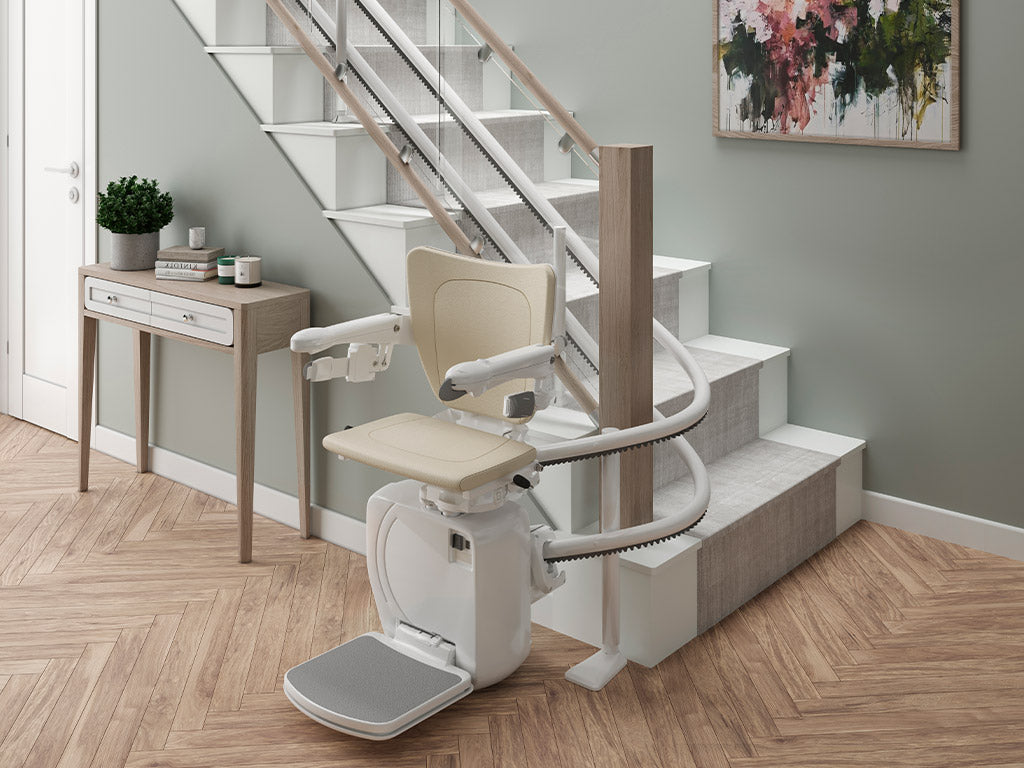
If your staircase turns a corner, has an intermediate landing, or follows a spiral, you need a curved stairlift. The rail is custom-manufactured to the exact shape of your staircase, which means a longer lead time and a higher cost. No two curved staircases are exactly alike, so no two curved stairlift rails are identical.
Outdoor stairlifts
Outdoor stairlifts are built for external steps: split-level gardens, steep front steps, or external access to outbuildings. They are designed to cope with weather, UV exposure, and temperature changes year-round.
Bariatric stairlifts
Standard stairlifts have a weight limit of around 100 to 125 kg. If you or the person you are buying for exceeds this, a bariatric stairlift is the right choice. These models are built with higher-capacity mechanisms and reinforced seating, typically supporting 160 kg to 200 kg or more.
Narrow and slim-rail stairlifts
Some older properties have staircases that are quite narrow. Slim-rail models are designed with a more compact footprint so the staircase remains passable for other household members when the lift is parked.
Perch and standing stairlifts
For users who find bending their knees into a seated position uncomfortable, perch or standing stairlifts offer an angled or semi-standing seat position. They are less common but worth discussing if standard seating feels unsuitable.
Wheelchair platform lifts
If you or the person using the stairlift uses a wheelchair and a transfer to a seat is not practical, a platform lift may be a better option. The platform carries the wheelchair and user together rather than requiring a seat transfer. These are larger and more involved to install than standard stairlifts, but they are the right solution when a seated model is not appropriate.
At Right Choice Mobility, we stock straight, curved, outdoor, and bariatric stairlifts, and we can advise on the right type for your staircase and circumstances.
How Much Does a Stairlift Cost in the UK?
Stairlift prices vary depending on the type, the manufacturer, the length of the rail, and any additional features you choose. The figures below are a useful guide, but the final price for your specific staircase will always depend on a proper assessment.
As a general guide for 2026:
- Straight stairlifts: from around £1,700 to £3,500
- Curved stairlifts: from around £3,500 to £7,000 or more
- Outdoor stairlifts: from around £3,000 to £5,500
- Bariatric stairlifts: from around £2,500 to £5,000+
- Reconditioned straight stairlifts: from around £700 to £2,500
What Affects the Cost?
Type of staircase
Straight staircases are straightforward to fit. Curved, spiral, or split-level staircases require custom rail manufacture, which increases both the cost and the lead time significantly.
Rail length
The longer your staircase, the more track is needed. A staircase with 14 steps costs more to fit than one with 10.
Features and options
Standard stairlifts are perfectly capable for most people. Optional upgrades include powered swivel seats, folding footrests, remote controls, upholstery choices, and key switches. Each adds to the overall price.
Installation complexity
Narrow hallways, awkward angles, or obstructions near the staircase can make installation more involved. This is why a home survey before quoting matters.
New versus reconditioned
A reconditioned stairlift that has been fully serviced and certified to manufacturer standards can offer genuine value for money, particularly for a straight staircase. Ask your supplier what they have available.
Aftercare package
Most stairlifts come with a warranty as standard, but the duration varies. Some suppliers include a service contract in the purchase price; others quote it separately. Annual servicing typically costs between £150 and £300, so factor this in from the start.
What Safety Features Should I Look For?
All reputable stairlifts include a standard set of safety features. Knowing what to look for gives you confidence in your choice and helps you assess what you are being offered.
The seat should swivel so that you can rotate to face the landing before you stand, reducing the risk of getting up at an awkward angle. A seatbelt is standard; good models offer a choice of belt style, and the right fit will depend on the user's build and preference.
Sensors along the footrest and rail detect any obstruction and stop the lift automatically, so a bag left on the stairs or a pet underfoot does not become a hazard. A smooth start and stop means the lift accelerates and decelerates gently rather than jolting.
Most stairlifts run from a rechargeable battery rather than drawing directly from the mains. This means the lift continues to work during a power cut, which is an important reassurance.
The rail is fixed to the stair treads, not the wall. This matters because it means installation does not require any structural work and removal leaves very little trace.
What Customisation Options Are Available?
Stairlifts can be personalised more than many people expect. The most common options are upholstery fabric and colour, which lets the lift sit comfortably within your existing decor rather than looking out of place. Rail colour is also usually customisable.
At the foot and head of the staircase, a folding rail section can be added so the rail folds out of the way when the lift is not in use. This keeps doorways and hallways clear and is worth considering if space at the top or bottom of the stairs is limited.
Powered footrests and swivel seats are worth considering if physical dexterity makes manual adjustments awkward. Dual remote controls, one at the top and one at the bottom of the stairs, are a practical addition for households where more than one person uses the lift.
Can I Get Help with the Cost?
The Disabled Facilities Grant
The Disabled Facilities Grant (DFG) is a means-tested grant from your local council to help with the cost of home adaptations, including stairlifts. In England, the grant can cover up to £30,000. The government committed £761 million to the DFG programme for 2025 to 2026.
To apply, you will need an assessment from an occupational therapist to confirm the adaptation is necessary and appropriate for your needs. The process takes time, so apply early if your need is not urgent. Your council's housing or adult social care team can advise on how to apply.
VAT relief
Stairlifts are zero-rated for VAT if you are chronically sick or disabled. The HMRC definition covers anyone with "a physical or mental impairment which has a long-term and substantial adverse effect on their ability to carry out everyday activities." At the point of sale, you complete a short self-declaration form and your supplier handles the rest. On a £2,500 stairlift, that means saving £500 compared to the standard rate.
If you are over 60 but do not meet the disability criteria, you may still qualify for a reduced VAT rate of 5% on installation. Ask your supplier what applies to you.
Charitable grants
Several charities offer grants to help with the cost of home adaptations. Organisations such as Age UK, SSAFA (for armed forces veterans and their families), and various local benevolent funds are worth contacting. Eligibility varies, but for those who qualify, the support can be substantial.
Finance
Many suppliers offer interest-free or low-rate payment plans to spread the cost over monthly instalments. If upfront cost is a concern, ask what finance options are available.
Our team at Right Choice Mobility is happy to talk through your options and advise on VAT relief eligibility.
Buying Versus Renting a Stairlift
Renting makes sense when the need is short-term: recovering from a hip or knee operation, for example, or providing temporary support while a longer-term plan is worked out. Monthly hire typically starts from around £30 to £75 per month for a straight stairlift on a rolling contract, though rates vary between suppliers.
Buying makes more sense when the need is ongoing. Over a year or two, the cost of rental often exceeds the purchase price, and ownership means the stairlift is there indefinitely without monthly outgoings.
If you are unsure whether to buy or rent, a conversation with the supplier is the best starting point. We offer stairlift hire and can talk through which arrangement makes more sense for your circumstances.
What Should I Look for in a Stairlift Supplier?
Choosing the right supplier matters as much as choosing the right stairlift. A few things worth checking before you commit.
Accreditations and independence. Look for suppliers who are Which? Trusted Trader accredited or members of the British Healthcare Trades Association (BHTA). An independent supplier, one not tied to a single manufacturer, can offer a broader range of products and give more objective advice about which model suits your situation best.
In-house servicing and repairs. Find out whether the company services and repairs the products it sells, or whether it outsources this to a third party. In-house capability means faster response times if something needs attention, and better accountability. At Right Choice Mobility, all servicing and repairs are handled by our own team, and we carry parts for the models we supply.
A proper home survey. A reputable supplier will always carry out a home assessment before providing a quote. This ensures the right product is specified for your staircase, and it gives you a chance to ask questions in person.
NHS approval and trusted trader status. Right Choice Mobility is an NHS-approved supplier and a Which? Trusted Trader, which means our service and quality standards have been independently assessed.
What Happens After Installation?
Installation is quicker than many people expect. A straight stairlift can typically be fitted in a single morning, around three to four hours. A curved stairlift takes around a full day to install, though the custom-manufactured rail must be made first, which usually takes three to five weeks from the survey date.
Once installed, a few things are worth knowing.
Most stairlifts run on a rechargeable battery rather than drawing directly from the mains. This means they continue to work during a power cut. The annual electricity cost of charging is typically just £10 to £20.
Annual servicing is recommended to keep the stairlift operating safely and to maintain your warranty. A service covers a safety inspection, lubrication of moving parts, drive testing, and battery check. We include servicing as standard for the first period after installation, and we offer ongoing service plans to keep things running smoothly.
Warranties vary between manufacturers. Most new stairlifts come with at least a one-year warranty, with options to extend. Ask your supplier what is included and what an extension costs before signing anything.
Removing a Stairlift When It's No Longer Needed
When a stairlift is no longer needed, removal is straightforward. Because the rail is fixed to the stair treads rather than the walls, there is very little structural disturbance and minimal trace left once the lift is gone.
Some suppliers offer a buy-back or part-exchange on straight stairlifts. It is worth asking about this at the point of purchase, since a reconditioned straight stairlift has genuine resale value. Some companies also refer units to refurbishment programmes. Ask your supplier what options are available.
Common Questions About Stairlifts
Are stairlifts only for older people?
No. Stairlifts are used by people of all ages following surgery, injury, or with a long-term condition that makes stairs difficult. Age is not a factor in whether a stairlift is suitable.
Will installation cause major disruption to my home?
Installation is generally quick and contained. A straight stairlift is typically fitted in a morning. An installer will need access to your staircase, but most of the rest of your home will be unaffected.
Will a stairlift block the stairs for other people?
When parked at the top or bottom, a stairlift folds flat against the wall, leaving the staircase passable. If the staircase is narrow, a slim-rail model or a folding rail section at the top or bottom can help further.
How much does a stairlift cost to run?
Very little. Stairlifts charge from a standard socket and typically cost between £10 and £20 a year in electricity. They do not require a dedicated circuit.
Can I try a stairlift before I buy?
Most people buying a stairlift are making a significant decision, often for themselves or for someone they care about. It makes sense to see the equipment in person before committing.
Our showroom in Highams Park is fully stocked with mobility equipment including stairlifts, and you are welcome to come in, ask questions, sit in the chairs, and get a feel for what suits you. There is no obligation to buy.
We are open Monday to Friday 9 am to 5 pm and Saturday 9:30 am to 4 pm.
If a showroom visit is not practical, we can come to you. A home survey gives us a chance to look at your staircase, understand your situation, and give you an accurate quote without any guesswork.
Ready to Find the Right Stairlift?
The two most important things are the shape of your staircase and the needs of the person using it. Getting the right advice at the start makes the whole process much simpler.
We would be happy to help. You can browse our full stairlift range, request a free quote, or call us on 0208 527 7487 for a no-obligation chat.