

You have no items in your shopping baskey.



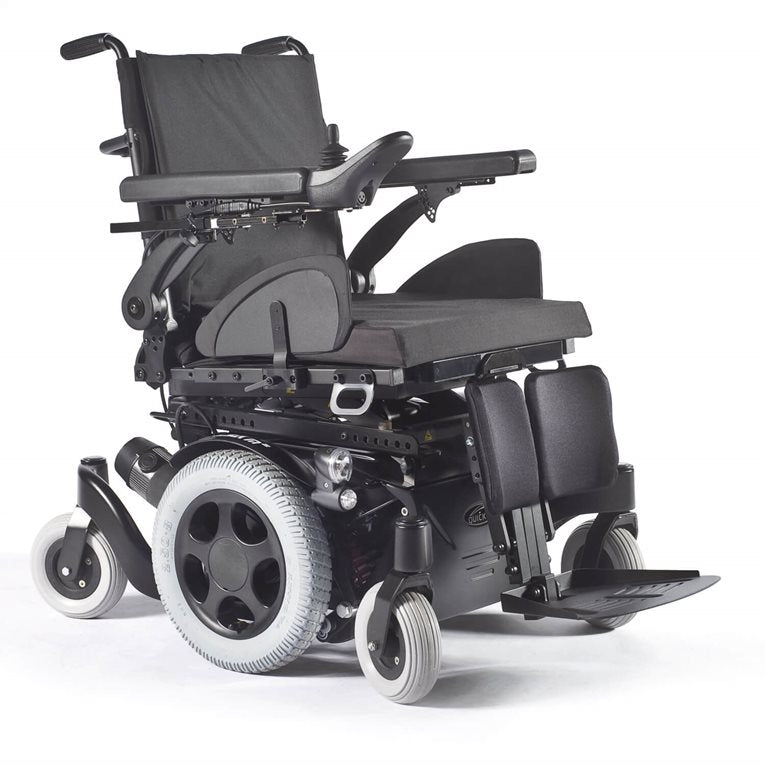
How to Choose a Powerchair: A Complete UK Buying Guide
Working out how to choose a powerchair can feel like a lot to take in at first, whether you're buying for yourself or researching on behalf of a parent, partner or someone you care for. It's a big purchase, the specifications are hard to compare side by side, and you want to get it right first time.
The good news is that it becomes far more manageable once you know which questions to ask. This guide walks through the things that really affect life with a powerchair day to day: where you'll use it, how it drives, what it costs, and who looks after it once it's yours.
What to look for in a powerchair:
- Where you'll use it, indoors, outdoors or both
- Drive type: front, mid or rear-wheel
- Comfort, seating and fit
- Battery range and charging
- Weight capacity and dimensions
- Folding, transport and storage
- Total cost, including VAT relief
- Trying it in person before buying
What Is a Powerchair?
A powerchair is a wheelchair driven by an electric motor and controlled by the person sitting in it, usually with a joystick, rather than pushed by an attendant or self-propelled by hand. In the UK, "powerchair", "power wheelchair" and "electric wheelchair" all mean the same thing and are used interchangeably.
This guide is about choosing the right chair rather than what's in stock today. To see models, prices and specifications, browse our powerchairs collection. And if you're still weighing up whether a powered chair is the right answer at all, our wheelchair buying guide covers manual and attendant-propelled options too.
Where and How You Will Use Your Powerchair
Start by deciding whether your powerchair will be used indoors, outdoors or a real mix of both. This one answer shapes almost every other choice you'll make. The compact dimensions that make a chair easy to live with at home are usually the opposite of what copes well with kerbs, hills and rough ground.
An indoor chair needs a tight turning circle, a narrow frame and enough clearance for internal doorways. An outdoor chair needs ground clearance, suspension, larger wheels and enough range to get you there and back with something in reserve. A chair that does both is a compromise, and often a sensible one, as long as you know which way it leans.
Think about the ground you actually cover. British pavements are rarely smooth, dropped kerbs aren't always where you need them, and wet grass, gravel and a steep hill ask far more of a chair than a showroom floor does. Be a little wary of "all-terrain" as a label, because what it means in practice varies a lot between models. It's always worth asking what a particular chair was designed to handle.
Measure your own home before you fall for a particular model. Doorway widths, hallway turns, the space beside the bed, the threshold at the back door: these are what decide whether a chair works in real life. If steps at the front or back of the property are the sticking point, that's worth solving separately, and our outdoor platform lifts are made for exactly that.
Types of Powerchair Drive: Front, Mid and Rear-Wheel Explained
Powerchairs come in three drive configurations, defined by where the powered wheels sit in relation to you. Front-wheel drive pulls well over kerbs and uneven ground, mid-wheel drive gives the tightest turning circle indoors, and rear-wheel drive tends to feel most stable at higher speeds on smooth surfaces.
Front-wheel drive: Powered wheels at the front, castors behind. Because the chair pulls rather than pushes, it climbs kerbs and copes with grass and gravel better than the alternatives. The trade-off is a larger turning circle than mid-wheel drive, and the rear can feel like it swings out until you're used to it.
Mid-wheel drive: Powered wheels directly beneath you, with castors front and rear. The chair pivots almost on the spot, making it the easiest of the three to manoeuvre indoors. The compromise is that the extra wheels can make steep kerbs and sharp changes in slope feel less settled.
Rear-wheel drive: Powered wheels at the back, castors at the front. This is the traditional layout, generally the most predictable at speed on pavements and paths, and often the most intuitive for someone who has driven a chair before. It needs the most room to turn, so it's the least forgiving in a smaller home.
There's no single right answer here. If this is your first chair, drive type is the one factor most worth testing in person, because the difference in feel is obvious within seconds of setting off.
Comfort, Seating and Fit
If you'll be in the chair for several hours a day, seating matters more than almost anything else on the specification sheet. Seat width and depth, backrest height, armrest style, footrest position and cushioning all affect posture, comfort and how tiring the day feels by the evening.
Look for adjustability. Flip-back armrests make side transfers easier and let you get closer to a table. Swing-away or elevating footrests help with access and swelling. On more specialist chairs, powered tilt, recline and seat riser functions let you change position through the day rather than staying in one fixed posture. Cushions are a decision in their own right, and foam, gel and air options all behave differently. You'll find them in our wheelchair accessories collection.
What we won't do is tell you which seating setup suits a particular condition or posture. That depends entirely on the individual, and it belongs with a healthcare professional or a proper assessment. If you're unsure, speak to our showroom team or ask about a home assessment before you commit to anything.
Battery Range and Charging
Quoted battery range is a best-case figure. Real range in the UK is usually lower, because cold weather, hills, soft or wet ground, stop-start driving and heavier loads all take their toll. Plan around a chair that comfortably beats your longest regular trip rather than one that just about matches it.
Battery type: Sealed lead-acid batteries cost less upfront but have a shorter working life. Lithium-ion batteries are lighter and generally last longer, at a higher initial price. Published lifespans vary a lot between sources and depend heavily on how the chair is used, so treat any figure as a rough guide and ask about the battery in the chair you're actually considering.
Charging routine: Motability's guidance on looking after a powered wheelchair recommends charging overnight as a habit and avoiding letting the battery run completely flat. It also notes batteries usually fade gradually rather than failing without warning, which gives you time to plan a replacement.
Where it charges: You'll need a socket near wherever the chair lives, and enough space to get the chair to it. If it will be stored in a garage or communal area, check whether the batteries are removable so they can come indoors, and check your building's rules if you live in a flat.
Weight Capacity and Size
Every powerchair has a maximum user weight set by the manufacturer, and it's worth checking rather than assuming. Leave some headroom for shopping, a bag or any equipment carried regularly, because the limit covers the total load, not just the person.
Dimensions matter just as much. Overall width decides whether the chair fits through your doorways, turning radius decides whether it works in your hallway, and seat-to-floor height affects transfers and whether your knees fit under a table. Where weight capacity, seat sizing or a bariatric requirement comes into it, talk to our team or arrange an assessment so the chair is matched to the person properly.
Folding, Transport and Storage
Be clear about what the chair needs to do when it isn't being driven. Does it need to go in a car boot several times a week, travel on a bus or train, be lifted by one person, or simply be parked and charged safely at home?
Folding and transportable powerchairs are very useful, but the trade-off is a real one. To fold down and stay light enough to lift, they tend to use smaller wheels, less suspension and smaller batteries, which usually means less range and less capability on kerbs, slopes and rough ground. If most of your driving is outdoors on difficult surfaces, a folding chair may be the wrong choice even though it's the easier one to store.
If lifting a chair isn't realistic, the answer is often to change how the chair gets moved rather than to shrink the chair itself. Our wheelchair lifts cover vehicle and home options that take the lifting out of it altogether. At home, a powerchair needs somewhere dry, level and easy to reach, close to a socket, and clear of a hallway or a fire escape.
Controls and Learning to Use Your Powerchair
The standard control is a joystick, usually mounted on either armrest and swappable between sides. Sensitivity, speed and acceleration can normally be adjusted, which makes a real difference for someone who's nervous at first or who finds fine hand movements difficult.
Where hand function is limited, there are alternative controls, including head, chin and tray-mounted options, plus attendant controls that let a family member or carer take over. These are specialist setups and they need a proper assessment, so speak to a healthcare professional or ask us to look at it with you rather than ordering on an assumption.
If this is your first powered chair, expect a bit of a learning curve. Judging kerbs, turning in tight spaces and getting in and out of lifts all take practice, and feeling wobbly for the first week or two is completely normal. Ask for a full handover on delivery, and don't hesitate to ask again later if something still isn't clicking.
Powerchair Classes and the Rules for Using Them in the UK
UK law treats powerchairs and mobility scooters as "invalid carriages" and splits them into two classes. A Class 2 chair has a maximum speed of 4mph and is for pavements and pedestrian areas, with no DVLA registration required. A Class 3 chair can reach 8mph and may be used on the road, but must be registered with the DVLA.
Most powerchairs bought for everyday indoor and outdoor use are Class 2, so for most buyers there's nothing to register and nothing to arrange. Class 3 is more often the territory of road-legal mobility scooters and a smaller number of outdoor chairs built for road use. According to GOV.UK's guidance on powered wheelchair classes, the practical differences are:
Speed: Class 2 is limited to 4mph. Class 3 can do 8mph on the road but is still limited to 4mph on pavements, so the pavement limit is identical for both.
Where you can go: Both classes can use pavements, pedestrian areas and cycle tracks separated from the road. Neither can use painted cycle lanes alongside traffic. Only Class 3 can be driven on the road, and never on a motorway.
Registration and tax: Class 3 vehicles must be registered with the DVLA, which the dealer normally handles for a new chair. Class 2 needs no registration. No vehicle tax is payable either way.
Equipment for road use: A Class 3 chair used on the road needs lights, reflectors, indicators, a rear-view mirror, a horn and an effective braking system.
Licence, insurance and age: No driving licence is needed for either class. Insurance isn't a legal requirement, though GOV.UK recommends it and so do we. The minimum age for using a Class 3 vehicle is 14, set out in the Use of Invalid Carriages on Highways Regulations 1988.
If you're unsure which class a chair falls into, ask before you buy. It's a simple question with a clear answer, and it decides where the chair can legally be used.
Cost, Funding and VAT Relief
Powerchair prices in the UK broadly run from around £1,000 for a compact folding chair up to £5,000 and beyond for a full-size chair with suspension, longer range and powered seating. Specialist chairs for complex postural needs go higher. Prices vary by model and are subject to change, and eligible buyers pay no VAT at all, which changes the maths considerably.
It's worth thinking about total cost rather than the price on the day. Batteries need replacing during the life of the chair, tyres wear out, and a repair on a chair with poor parts availability can quietly swallow whatever you saved at the outset.
VAT Relief on Powerchairs
If you're chronically sick or disabled, you can buy a powerchair free of VAT, at any age. GOV.UK's guidance on VAT relief for disabled people confirms this is a 0% rate on qualifying goods rather than a reduced rate, so you save the full VAT amount.
Who qualifies: Anyone with a physical or mental impairment that has a long-term and substantial effect on their ability to carry out everyday activities, anyone with a condition treated as a chronic sickness, and anyone who is terminally ill. Age alone doesn't qualify you, and nor does a temporary injury such as a broken leg.
What you need to provide: A written eligibility declaration, which we give you and which takes a couple of minutes to complete. There's no medical certificate or GP letter needed, and the declaration stays with us for our VAT records rather than going to HMRC. A family member or carer can fill it in on behalf of the person who'll be using the chair.
What it covers: The chair itself, plus repairs, maintenance, spare parts and accessories connected with it, provided the chair is for personal or domestic use.
You may have seen a 5% reduced VAT rate mentioned in connection with mobility aids. That one applies to a specific list of products supplied and installed in the home for people aged 60 or over, covering stairlifts, grab rails, ramps and walk-in baths among others. Powerchairs aren't on that list, so the 0% route is the one that applies here. If you're not sure whether you qualify, ask us and we'll talk it through with you.
The Motability Scheme
If you receive the enhanced or higher rate mobility component of PIP, DLA, Adult Disability Payment, Child Disability Payment or Scottish Adult DLA, or you receive Armed Forces Independence Payment or War Pensioners' Mobility Supplement, you may be able to lease a powered wheelchair through the Motability Scheme instead of buying one. You normally need at least 12 months left on the award and can only hold one lease at a time.
The appeal is that the lease package is all-inclusive, covering insurance, servicing, breakdown cover and battery and tyre replacement. Around 890,000 people now lease through the scheme across cars, wheelchair accessible vehicles, scooters and powered wheelchairs. We're a Motability Scheme partner for scooters and powered wheelchairs, so we can go through your options with you.
The NHS Route
The NHS does provide powered wheelchairs in some circumstances. NHS guidance on wheelchairs and mobility aids explains that you need a referral to your local wheelchair service for an assessment, usually through a GP, physiotherapist, occupational therapist or hospital staff, though some areas allow self-referral. Mobility scooters, by contrast, aren't generally available on the NHS.
Since 2 December 2019, anyone using wheelchair services whose posture and mobility needs affect their wider health and social care needs has a legal right to a personal wheelchair budget, which can be put towards a chair outside the standard NHS range.
The one caveat is timing. NHS England measures wheelchair services against a target of 92% of referrals resulting in delivery or a modification within 18 weeks, and that target is consistently missed. In the quarter from January to March 2025, 80.8% of adults and 77.9% of children received their wheelchair or modification within 18 weeks. That's not a reason to avoid the NHS route, and for complex seating needs it's still the right one. It's simply why a lot of people start the NHS process and buy privately in the meantime. We're an NHS approved supplier, and we're happy for you to pursue both at once.
Reliability, Servicing and Support After You Buy
A powerchair that's off the road for weeks waiting on a part isn't much use to you, however good the specification looked on paper. It's the part of the decision most buying guides skip over, and the part owners tend to talk about most once they've lived with a chair for a while.
We're not going to put a number on breakdown rates, because there isn't a reliable UK figure we'd be comfortable quoting. What we can do is tell you what to ask before you hand any money over.
Who services it, and where? Ask whether servicing and repairs are handled in house or subcontracted, and whether an engineer can come to you rather than the chair having to be transported. We handle servicing, repairs and parts in house, which is usually the difference between a job being scheduled and a job being passed along.
How are parts supplied? Powerchair parts are usually model-specific rather than universal, so repairs are more often held up by parts lead time than by labour. Ask whether the supplier stocks parts for the model you're buying, and how long a part takes to arrive if it isn't held in stock.
What does the warranty cover? Check the length, whether it covers parts and labour, and whether batteries are treated separately, as they very often are.
How often should it be serviced? Most UK mobility retailers settle on an annual professional service as standard practice, with more frequent checks for heavy use or a hard winter. That's industry practice rather than a legal requirement, but it's sound advice. Between services, simple monthly checks on tyres, connections and general condition go a long way.
Can you get hold of someone? A supplier with a real premises and a phone number you can ring is a lot easier to deal with when something goes wrong than an online-only listing.
Trying Before You Buy
Sit in the chair and drive it before you commit. It's the single most useful thing you can do, and it's the advice we'd give anyone. Photographs and specification sheets tell you dimensions and battery capacity. What they can't tell you is how the seat feels after 40 minutes, how the chair handles a kerb, whether the joystick sits comfortably under your hand, or whether the turning circle works in a space the size of your hallway.
Our showrooms in London and Essex are set up for exactly this. You can try different drive types back to back, compare seating, ask the awkward questions and take as long as you need. We're on the Chingford, Highams Park and Walthamstow border, as well as our newest shop in Loughton. We're open Monday to Friday, 9am to 5pm, and Saturday, 9:30am to 4pm.
If travelling is difficult, or what you really need to know is whether a chair works in a particular home, a home assessment answers things a showroom can't: the doorway that's fractionally too narrow, the threshold at the back door, where the chair will live and charge. We also offer free local delivery and home assembly, so the chair arrives set up and ready rather than in a box.
For short-term needs, or where you're simply not sure yet, we hire out wheelchairs and other equipment. It's a sensible way to find out how much a chair actually gets used before making a bigger commitment. We're also Which? Trusted Trader accredited, if you're checking us out before you visit.
Making the Right Choice
Choosing a powerchair comes down to a handful of straightforward questions. Where will it be used? How much ground does it need to cover? Who's going to lift or transport it? What does it need to cost, and who'll look after it in three years' time?
When you're ready to see what's available, browse our powerchairs collection. If you'd rather talk it through first, which is what we'd usually suggest for a purchase like this, come and see us or get in touch, or call the team on 0208 527 7487. Whether you're buying for yourself or for someone close to you, there's no such thing as too many questions.
Frequently Asked Questions
What Is the Difference Between a Powerchair and an Electric Wheelchair?
There's no difference. "Powerchair", "power wheelchair" and "electric wheelchair" all describe the same thing in the UK: a wheelchair driven by an electric motor and controlled by the user, usually with a joystick. Retailers and manufacturers use the terms interchangeably, so don't read anything into which one a listing uses.
Can I Try a Powerchair Before I Buy It?
Yes, and you should. Trying a chair in person is the most useful thing you can do before buying, because comfort, joystick position, turning circle and how a chair handles a kerb can only really be judged by sitting in it. Photographs and specification sheets aren't a substitute. Visit our Highams Park showroom to compare models, or ask about a home assessment if travelling is difficult.
Can I Take a Powerchair on a Bus or Train?
Usually yes, particularly with a folding or transportable model, but always check with the specific operator first. Bus and rail companies set their own limits on the size and weight of powered chairs they carry, and those limits vary. The Class 2 and Class 3 distinction affects where a chair can be driven on roads and pavements, not whether public transport will take it.
How Much Does a Powerchair Cost in the UK?
Powerchairs generally range from around £1,000 for a compact folding chair to £5,000 or more for a full-size chair with suspension, longer range and powered seating, with specialist chairs going higher. Prices are subject to change. If you're chronically sick or disabled you can buy free of VAT. And bear in mind that the lowest-priced chair isn't always the lowest total cost once batteries, parts and repairs are counted.
Do I Need an Occupational Therapist Assessment to Buy a Powerchair?
No, not for a chair bought privately. A professional or supplier assessment is still strongly recommended, particularly where posture, pressure care or a complex condition is involved, because fit matters more on a powered chair than most people expect. The NHS route does involve an assessment through your local wheelchair service, and waits can be long, which is why many people buy privately while that process runs.
What Is the Difference Between a Powerchair and a Mobility Scooter?
A powerchair is designed for indoor as well as outdoor use and generally needs less strength, balance and hand dexterity, since it's driven with a joystick from a supportive seat. A mobility scooter is steered with handlebars, asks more of your upper body strength and trunk stability, and is mainly for outdoor use. If in doubt, try both.